Why AI photography appeals to couples and families in 2026

Most people assume AI-generated photography lacks the personal touch needed for meaningful family moments. That’s wrong. In 2026, AI photography has become a powerful tool for couples and families seeking unique, personalized images that traditional photography simply cannot create. From visualizing future babies to crafting romantic milestone portraits, AI technology now delivers photorealistic results that capture genuine emotion and identity. This guide reveals how AI photography works, why it resonates emotionally despite perception challenges, its current limitations, and practical ways to leverage it for your most cherished memories.
Table of Contents
- Understanding AI Photography Technology And Its Appeal
- Emotional Connections And The Unique Appeal Of AI Images For Romantic Milestones
- Current Limitations And Challenges In AI Photography Quality And Perception
- Applying AI Photography For Couples And Families: Practical Tips And Future Trends
- Discover Personalized AI Couple And Family Photo Solutions
- Why AI Photography Appeals To Enthusiasts: FAQ
Key takeaways
| Point | Details |
|---|---|
| Personalized romantic imagery | AI creates unique couple photos and family visualizations impossible with traditional photography |
| Perception challenges exist | Anti-AI bias affects ratings, but education and positive attitudes improve acceptance |
| Technology has limits | Current AI excels at photorealism but struggles with complex spatial details |
| Prompt quality matters | Expert prompt engineering dramatically improves image relevance and visual fidelity |
| Ethical use is essential | Responsible AI photography requires awareness of copyright, consent, and potential misuse |
Understanding AI photography technology and its appeal
AI photography relies on sophisticated deep learning systems that transform text descriptions into photorealistic images. Diffusion models iteratively refine images from random noise, guided by your text prompts, until they match your vision. These models contain billions of parameters that encode visual knowledge. The Z-Image generative model uses 6 billion parameters to synthesize highly detailed images efficiently.
For couples and families, this technology opens creative possibilities that traditional photography cannot match. You can visualize milestone moments before they happen, create romantic portraits in fantasy settings, or see what your future child might look like. The emotional appeal is immediate and powerful.
The quality of your results depends heavily on prompt engineering. Vague descriptions produce generic outputs. Specific style keywords, detailed scene descriptions, and precise emotional cues guide AI systems to generate AI family photos that feel authentic and personal. Mention lighting conditions, clothing styles, background elements, and facial expressions to improve accuracy.
Key technical factors that enable personalization include:
- Advanced facial recognition that preserves individual identity across generated images
- Style transfer capabilities that apply artistic themes while maintaining photorealism
- Compositional understanding that places subjects naturally within scenes
- Texture rendering that creates realistic skin, hair, and fabric details
Following best practices for AI-generated portraits ensures you avoid common artifacts like distorted hands, unnatural lighting, or inconsistent facial features. The technology works best when you provide clear reference photos and specific creative direction.
Pro Tip: Include style keywords like “soft natural lighting,” “shallow depth of field,” or “golden hour glow” in your prompts to achieve professional photography aesthetics and reduce artificial-looking results.
The appeal extends beyond technical capability. AI photography lets you experiment with creative concepts without expensive photoshoots. You can explore different themes, settings, and styles instantly. For couples celebrating anniversaries or planning weddings, this means creating best AI photo results for couples and babies that capture their unique relationship.
Emotional connections and the unique appeal of AI images for romantic milestones
AI-generated photos create emotional resonance by offering something human photography cannot: the visualization of imagined moments and futures. Couples use AI to see themselves in dream wedding settings, romantic vacation destinations they haven’t visited, or styled portrait sessions they cannot afford. The personalization makes these images feel meaningful rather than generic.

However, perception challenges exist. Research shows identical romantic images labeled AI-generated received less positive evaluations than those labeled human-generated. This anti-AI bias affects how people emotionally respond to the same visual content based solely on its origin label.
Interestingly, AI attitudes and literacy moderate perception of AI images significantly. People with positive attitudes toward AI technology and higher AI literacy show reduced bias. They appreciate AI photos for their creative potential rather than dismissing them as inferior. Education matters.
Anti-AI bias challenges acceptance, but education and positive attitudes foster enthusiasm for AI photography.
Despite perception hurdles, user interest in personalized AI-generated content continues growing. Couples and families recognize that AI enables entirely new categories of meaningful imagery. The emotional appeal comes from several factors:
- Complete personalization using your actual photos and features
- Creative freedom to explore impossible scenarios and fantasy settings
- Future visualization showing what children might look like or milestone moments ahead
- Unique imagery that no one else will ever have
AI photos serve as creative gifts that carry personal significance. A couple might create anniversary portraits in the style of their favorite film era. Parents might visualize their future family before conception. These uses tap into deep emotional desires that traditional photography cannot address.
The technology also democratizes access to high-quality romantic imagery. Professional couple photoshoots cost hundreds or thousands of dollars. AI photography delivers comparable visual quality at a fraction of the cost, making personalized romantic images accessible to everyone.
Understanding why accuracy matters in AI photo generation helps explain the emotional connection. When AI captures your actual facial features, expressions, and characteristics accurately, the resulting images feel genuinely personal. Poor accuracy produces generic faces that lack emotional resonance.
The shift from anti-AI bias to enthusiasm happens when people experience well-executed AI photography firsthand. Seeing yourself rendered beautifully in a creative concept you imagined changes perception. The technology becomes a tool for self-expression rather than a threat to authenticity.
Current limitations and challenges in AI photography quality and perception
While AI photography delivers impressive photorealism, significant technical limitations persist. Understanding these constraints helps set realistic expectations and guides effective use of the technology.
AI image generators often misinterpret spatial relationships and logical consistency, causing noticeable errors. Common issues include:
- Spatial relationship errors where objects overlap incorrectly or perspective breaks down
- Object independence failure causing merged or duplicated elements that should be separate
- Repetition artifacts creating unnatural patterns in backgrounds or textures
- Resolution constraints limiting fine detail in complex scenes
- Inconsistent lighting that doesn’t match across all elements in a composition
These limitations become especially apparent in images with multiple people, complex backgrounds, or detailed props. A romantic couple portrait might render faces beautifully but struggle with hand positions or background architecture.
Recent advances like UltraImage improve visual fidelity and reduce repetition artifacts significantly. The model supports higher resolution generation, addressing one of the most persistent quality complaints. However, even advanced systems still make logical errors that human photographers would never produce.
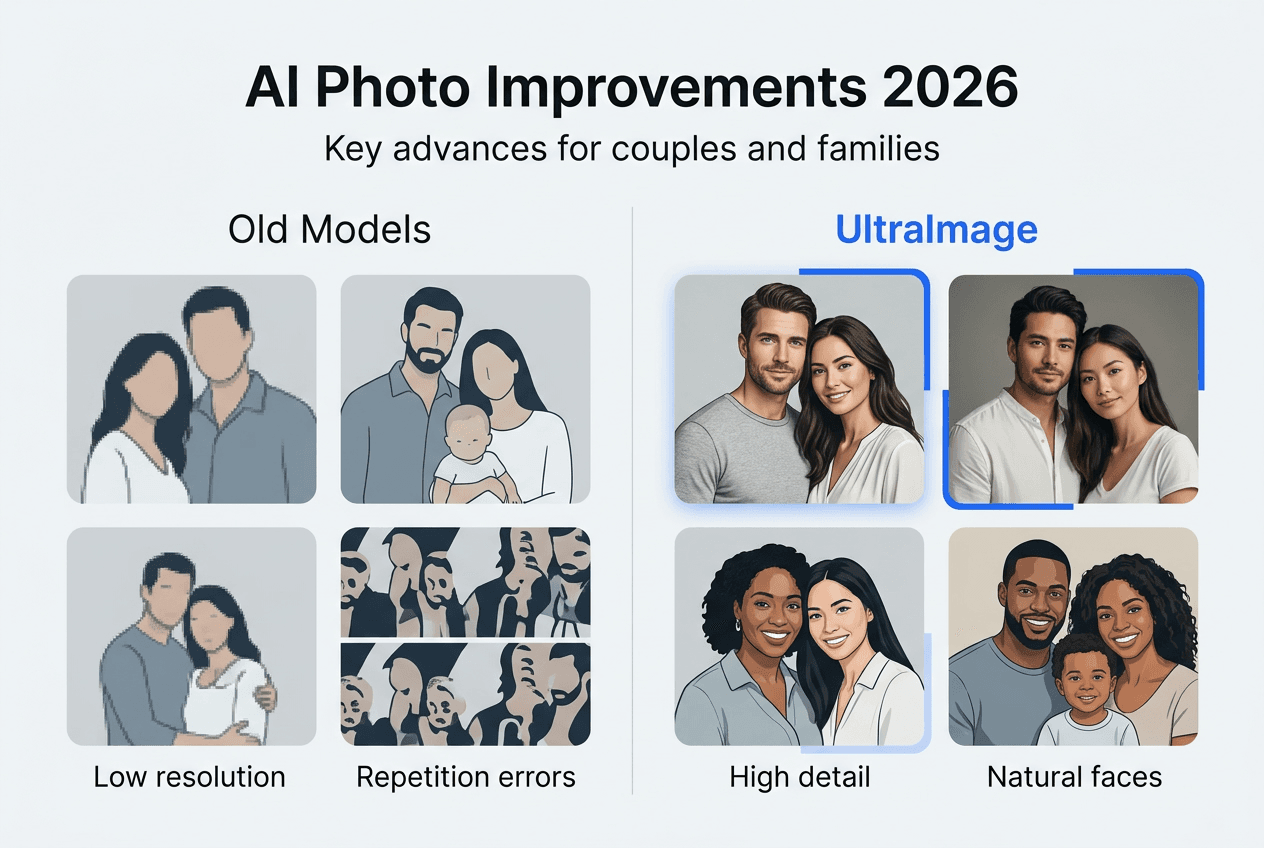
| Feature | Typical Generative Models | UltraImage Improvements | | — | — | | | Maximum resolution | 1024x1024 pixels | Up to 6144x6144 pixels | | Repetition artifacts | Common in backgrounds | Significantly reduced | | Detail consistency | Degrades at higher resolutions | Maintains quality across scales | | Generation speed | Fast for standard sizes | Optimized for large outputs |
Beyond technical issues, ethical concerns in AI content create perception challenges. Questions about copyright, consent, and potential misuse affect public acceptance. When you generate an image of yourself and your partner, who owns the copyright? Can AI systems trained on copyrighted photos ethically create derivative works?
The technology also enables potential misuse. Deepfakes and non-consensual imagery represent serious ethical problems that the industry continues addressing through technical safeguards and policy frameworks. Responsible platforms implement verification and consent mechanisms.
For personal use, these ethical considerations mean being thoughtful about how you create and share AI-generated photos. Generate images only of yourself and people who have given explicit permission. Avoid creating misleading content that could be mistaken for real photography in contexts where authenticity matters.
Pro Tip: Always review AI-generated images critically for anatomical errors, lighting inconsistencies, or unnatural elements before using them for important purposes, and consider combining AI generation with modest manual editing for professional results.
Understanding why accuracy matters helps you work around limitations. When you know AI struggles with hands, you can choose poses that minimize hand visibility or plan to edit them afterward. When you understand spatial relationship challenges, you can simplify compositions.
Following best practices for AI-generated portraits helps you avoid common pitfalls and maximize quality within current technological constraints.
Applying AI photography for couples and families: practical tips and future trends
Getting excellent results from AI photography requires strategic approach and realistic expectations. Expert prompt engineering is critical for generating high-quality, relevant images that match your vision.
Start with concise, descriptive prompts that specify style, setting, and emotion. Instead of “romantic couple photo,” try “soft-focus couple portrait, golden hour lighting, beach sunset background, warm intimate mood, shallow depth of field.” Specific details guide AI systems more effectively.
Leverage specialized tools designed for your use case. AI couple photo makers and AI baby generators optimize their models specifically for these applications, delivering better results than general-purpose systems.
Practical tips for achieving the best results:
- Prepare clear, well-lit reference photos showing your face from multiple angles
- Choose meaningful themes that reflect your relationship or family vision
- Experiment with different artistic styles to discover what resonates emotionally
- Verify outputs critically for technical errors before using them for important purposes
- Start with simpler compositions and gradually increase complexity as you learn
Future trends point toward continued improvement in AI photography capabilities. UltraImage enables generation of very large images up to 6144x6144 pixels, supporting print-quality outputs. Expect steady advances in logical consistency, spatial understanding, and detail rendering through 2026 and beyond.
Emerging capabilities include better understanding of complex scenes with multiple subjects, improved rendering of difficult elements like hands and eyes, and enhanced editing capabilities that let you modify specific aspects of generated images without starting over.
The technology will likely become more accessible and user-friendly. Current systems require some technical knowledge to achieve optimal results. Future tools will automate more of the prompt engineering process while still allowing creative control.
Following best AI portrait practices positions you to take advantage of improvements as they arrive. The fundamental principles of good composition, lighting, and emotional authenticity remain constant even as technical capabilities evolve.
Pro Tip: Combine AI generation with modest manual editing using photo editing software to perfect final images for keepsakes and gifts, correcting any minor artifacts while preserving the overall AI-generated composition and style.
As models improve and public understanding grows, AI photography will become a standard tool for couples and families creating personalized visual memories. The technology already delivers remarkable results. Future advances will make those results even more impressive and accessible.
Discover personalized AI couple and family photo solutions
Creating meaningful AI-generated photos requires specialized tools designed specifically for couples and families. PairFuse offers AI-powered solutions that transform your personal photos into photorealistic images capturing romantic milestones and family visions.
The AI couple photo maker combines photos of both partners into unique romantic portraits across diverse themes. From intimate studio sessions to fantasy wedding scenarios, the platform maintains facial identity and natural chemistry. The AI baby generator creates realistic visualizations of future children based on parent photos, offering an emotionally engaging glimpse into family possibilities.

These specialized tools deliver benefits that general AI systems cannot match:
- Photorealistic quality preserving true-to-life facial features and expressions
- Extensive customization options across romantic and family themes
- Quick results without complex prompting or technical expertise
- Unique gift ideas for anniversaries, engagements, and special occasions
For couples planning weddings, the AI wedding photo maker generates stunning bridal imagery in styles ranging from classic elegance to modern editorial. You can explore different wedding aesthetics before your actual day or create commemorative images afterward.
Pro Tip: Explore multiple AI photography tools to discover which best captures your vision for personalized romantic and family images, and don’t hesitate to generate several variations of your favorite concepts.
Why AI photography appeals to enthusiasts: FAQ
How does AI photo quality compare to traditional photography?
AI photography now achieves photorealistic quality rivaling professional photography for portraits and romantic imagery. However, AI still struggles with complex spatial details and can produce anatomical errors that human photographers avoid. The technology excels at creative visualization and personalization that traditional photography cannot offer.
What makes AI-generated couple photos feel emotionally meaningful?
Personalization creates emotional connection. When AI accurately captures your facial features and places you in meaningful scenarios, the images feel genuinely personal rather than generic. The ability to visualize imagined moments and future possibilities adds unique emotional value that standard photography cannot provide.
Are there ethical concerns with using AI photography?
Yes. Generate images only of yourself and people who have given explicit consent. Avoid creating misleading content or using AI to produce non-consensual imagery. Responsible platforms implement safeguards, but users must also practice ethical judgment about how they create and share AI-generated photos.
How can beginners start with AI photography safely?
Start with reputable platforms designed specifically for couples and families. Use clear reference photos, begin with simple compositions, and follow best AI-generated portrait practices. Review outputs critically before sharing, and understand that some experimentation is necessary to achieve optimal results.
Will AI photography replace traditional couple photography?
No. AI photography serves different purposes. Traditional photography captures real moments with authentic spontaneity and professional artistic direction. AI photography enables creative visualization, future planning, and personalized imagery that physical photoshoots cannot create. Both have distinct value for couples and families.
What improvements can we expect in AI photography by 2027?
Expect higher resolution outputs, better logical consistency in complex scenes, improved rendering of challenging elements like hands, and more intuitive editing capabilities. Models will likely become more accessible while delivering increasingly photorealistic results that reduce current technical limitations.
Recommended
- Best AI photo results for couples & babies 2026
- Generate AI family photos with true likeness in 2026
- Best practices for AI-generated portraits in 2026
- Why accuracy matters in AI photo generation in 2026
- Master photojournalism in travel storytelling in 2026
- Astrology in 2026: Personalized Insights Powered by AI | Lunaris